


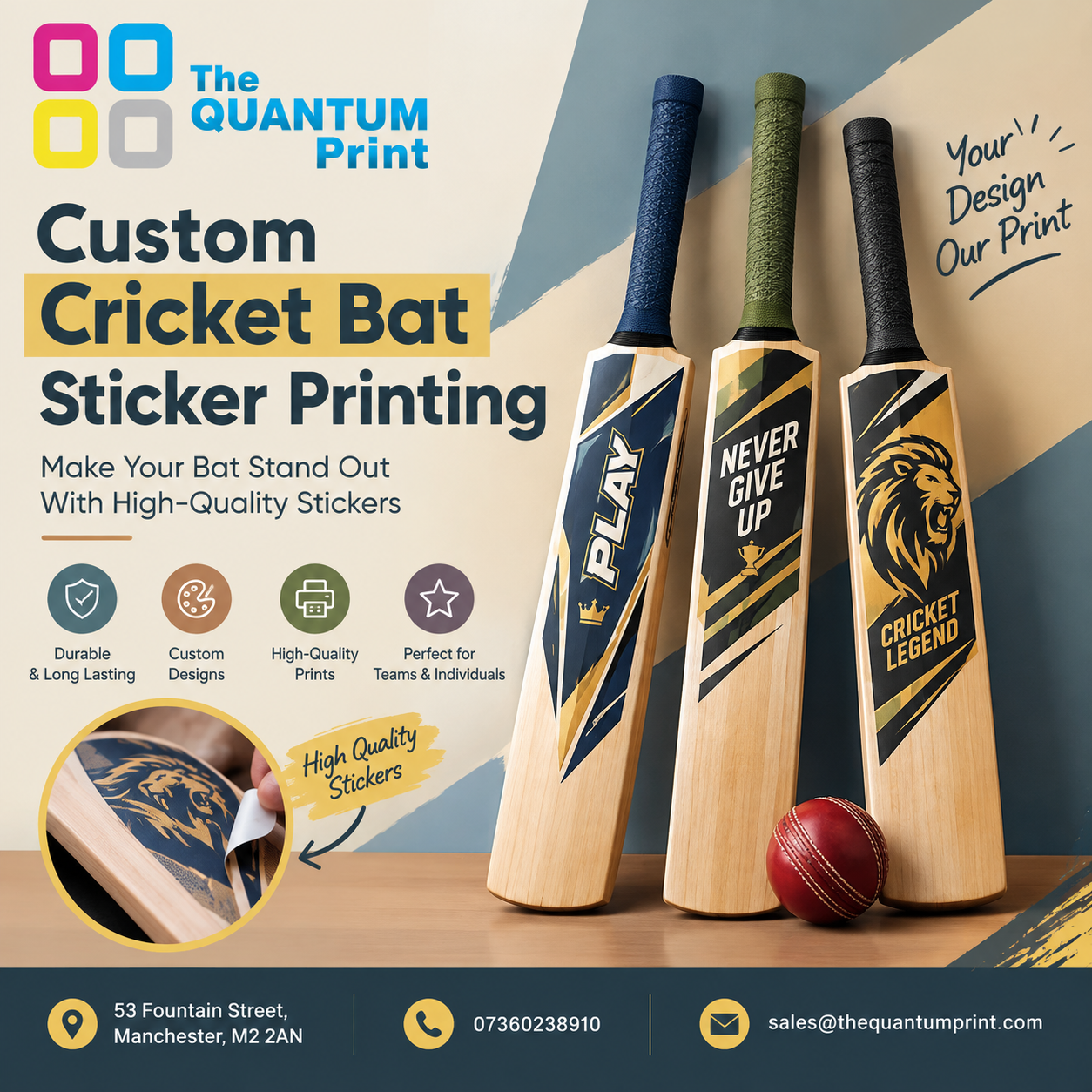
Cricket equipment is becoming increasingly personal, with players looking for ways to express their identity while maintaining a professional appearance on the field. One simple way to achieve this is through bat customisation. From club colours to individual names and distinctive graphics, personalized cricket bat stickers allow players to create equipment that reflects their style without changing the fundamental characteristics of the bat.
In the United Kingdom, where cricket is played across schools, amateur clubs, academies, and professional leagues, customised bat graphics also serve a practical purpose. They help distinguish equipment, reinforce team identity, and create a consistent visual appearance. Understanding materials, printing methods, and application techniques can help players and teams make informed decisions when selecting cricket bat stickers.

1. Why Cricket Bat Sticker Customisation Is Growing
Personalisation has become an important trend across sports equipment. Players increasingly value products that combine functionality with individual expression. Cricket bats are particularly suitable for this approach because their flat front and back surfaces provide space for decorative graphics, names, logos, and colour schemes.
Modern unique cricket bat stickers can serve several purposes:
- Personal identity: Players can incorporate their names, initials, or preferred colours.
- Club representation: Teams can use matching designs to create a consistent appearance.
- Brand recognition: Manufacturers and cricket-related businesses can display logos and visual identities.
- Equipment identification: Distinctive designs make it easier to recognise a bat in shared changing rooms or team equipment areas.
- Personalised gifts: Custom graphics can make cricket bats more memorable as gifts for birthdays, tournaments, and other sporting occasions.
Although appearance is important, sticker selection should also consider durability, surface compatibility, and the conditions in which the bat will be used.
2. Choosing Materials for Stickers on Cricket Bats
Material selection plays a major role in the appearance and lifespan of stickers cricket bat designs. Cricket bats are exposed to friction, handling, dust, and occasional moisture. A sticker that looks impressive when first applied may not perform well if its adhesive or surface material is unsuitable.
Common material options include vinyl films, printed adhesive sheets, and specialised label materials. Each offers different characteristics.
Vinyl stickers are often considered for their flexibility, colour reproduction, and ability to accommodate detailed graphics. Depending on the specific material and adhesive, they may provide good resistance to everyday handling and surface wear.
Lightweight adhesive films can be useful when the aim is to add decorative details without creating unnecessary bulk. Their suitability depends on the intended placement and the bat’s existing finish.
Protective laminates may be applied over printed graphics to improve resistance to abrasion and minor surface damage. However, not every sticker requires lamination, and the additional layer should be compatible with the chosen material.
Before selecting a product, consider the following factors:
- Adhesion to the intended bat surface.
- Resistance to scuffing and routine handling.
- Colour accuracy and print clarity.
- Flexibility around gently curved areas.
- Ease of application and removal.
- Compatibility with any existing protective coating.
Players should also remember that stickers do not repair structural damage to a bat. Cracks, loose handles, or other defects require appropriate inspection and maintenance.
3. Designing Custom Cricket Bat Stickers That Stand Out
Good design involves more than choosing attractive colours. The most effective custom cricket bat stickers balance visual impact with readability and practical placement.
A useful starting point is the intended purpose of the design. A club bat may need a recognisable team logo, while an individual player might prefer a name, initials, or a distinctive colour combination.
Several design principles can improve the final result.
Keep important details readable. Small text can become difficult to recognise when printed on a compact surface. Use clear fonts, sufficient contrast, and simple layouts.
Choose colours carefully. Contrasting colours help logos and lettering remain visible. When matching existing club branding, use consistent colour values wherever possible.
Prepare artwork correctly. High-resolution files help preserve sharp edges and clear lettering. Vector artwork is particularly useful for logos because it can be resized without losing quality.
Measure the available space. The sticker should fit the intended area without interfering with the bat’s natural contours or existing graphics.
Consider the complete appearance. A design should complement the bat’s finish rather than overwhelm it. Consistent spacing, balanced proportions, and restrained use of decorative elements often produce a more professional result.
For those planning a design from scratch, a cricket bat sticker maker or professional design service can help organise artwork, colours, lettering, and dimensions before printing begins.
4. Cricket Bat Sticker Printing: From Artwork to Application
Successful cricket bat sticker printing depends on preparation as much as the printing process itself. Clear artwork, accurate sizing, suitable materials, and careful application all contribute to the finished appearance.
The process generally follows four stages.
Stage one: Artwork preparation. Finalise the logo, text, colours, and dimensions. Check spelling carefully and ensure that images have sufficient resolution.
Stage two: Material and print selection. Choose a printable material and adhesive appropriate for the intended surface. Printing methods vary according to order quantity, colour requirements, material, and design complexity.
Stage three: Proofing and production. Review a digital proof or physical sample when available. This helps identify colour differences, alignment problems, and sizing errors before a larger batch is produced.
Stage four: Application. Clean the surface according to the bat manufacturer’s guidance and allow it to dry completely. Position the sticker carefully, apply it gradually, and smooth out trapped air without stretching the material.
Common problems include peeling edges, air bubbles, inaccurate colours, and graphics that are too large for the available space. These can often be reduced through careful measurement, compatible materials, and a controlled application process.
For reference, The Quantum Print provides information about cricket bat sticker options and customisation through its dedicated page: https://www.thequantumprint.com/cricket-bat-stickers/.
5. Practical Considerations for Clubs, Players, and Retailers
Different users have different requirements when planning customised cricket equipment.
Individual players generally prioritise personal style and small quantities. Clubs may require consistent designs across multiple bats, making repeatable colours, artwork files, and standardised dimensions particularly important. Retailers and cricket-related businesses may focus on branding consistency, production planning, and reliable presentation across product ranges.
Before arranging an order, establish:
- The number of stickers required.
- The final dimensions and intended placement.
- The preferred colours, logos, and lettering.
- The expected playing and storage conditions.
- Whether replacement stickers may be needed later.
- The production timeline and proofing requirements.
Ordering a sample can be particularly useful when testing a new material or design. It provides an opportunity to check appearance, adhesion, and fit before committing to a larger quantity.
Conclusion
Cricket bat personalisation brings together design, printing technology, and practical equipment care. Well-planned personalized cricket bat stickers can help players express their individuality, clubs maintain a consistent identity, and retailers create distinctive sporting products.
The most reliable results come from choosing suitable materials, preparing accurate artwork, checking dimensions, and applying stickers carefully. By considering these factors before printing, players and organisations can achieve a professional finish while ensuring that customisation remains appropriate for the bat’s intended use.
Contact Us : https://www.thequantumprint.com/contact-us/
About Us : https://www.thequantumprint.com/about-us/
Website Link : https://www.thequantumprint.com/

 Arabic
 French
 Spanish
 Portuguese
 Deutsch
 Turkish
 Dutch
 Italiano
 Russian
 Romaian
 Portuguese (Brazil)
 Greek